Room Service: The Quiet Rules of Britain’s Karaoke Booths
The big stage is a lie. Or at least a relic. In Britain, karaoke has retreated behind a door with a small window, into a room that smells faintly of disinfectant and ambition. The private booth — bookable by the hour, lit like a low-budget music video, furnished with a sofa that has heard things — is now the most social square footage in town.
It is not a new idea. Karaoke boxes have been a fixture in East Asia for decades, and British cities have been quietly installing them for years. But something has shifted. The private room no longer feels like a novelty; it feels like the point. A big stage asks you to perform for strangers. A booth asks you to perform for your friends, which is simultaneously easier and much, much harder.
The Booking Ritual
Every karaoke night begins with a WhatsApp thread that reads like a minor diplomatic negotiation. Someone becomes the booker — usually the person with the most patience and the least desire to sing first. They will discover that most UK booths operate on timed slots, minimum spends and deposits, and that the difference between a good night and a bad one is often whether you booked the 7pm or the 9pm slot.
The booking confirmation arrives with the gravity of a boarding pass. Room 4. Two hours. Minimum spend £40. Please arrive ten minutes early. In practice, this means the group will assemble outside in a loose semicircle, one person will be late, and someone will suggest a pint nearby that they will have to abandon halfway through. The handover at the desk is terse and efficient: a clipboard, a room number, a warning about the microphone volume. You are not customers so much as temporary tenants.
Reading the Room, Literally
The booth is a design document. Look at the song book — not the digital menu, the laminated binder, if there is one. A pristine book suggests a venue that has not yet found its regulars. A book with dog-eared corners, Biro stars and a suspicious stain near the ballads section tells you this room has a history. The pages that fall open first are the pages that get sung. In most British booths, that means “Mr Brightside”, “Wonderwall”, “Angels” and something by ABBA that nobody will admit to choosing.
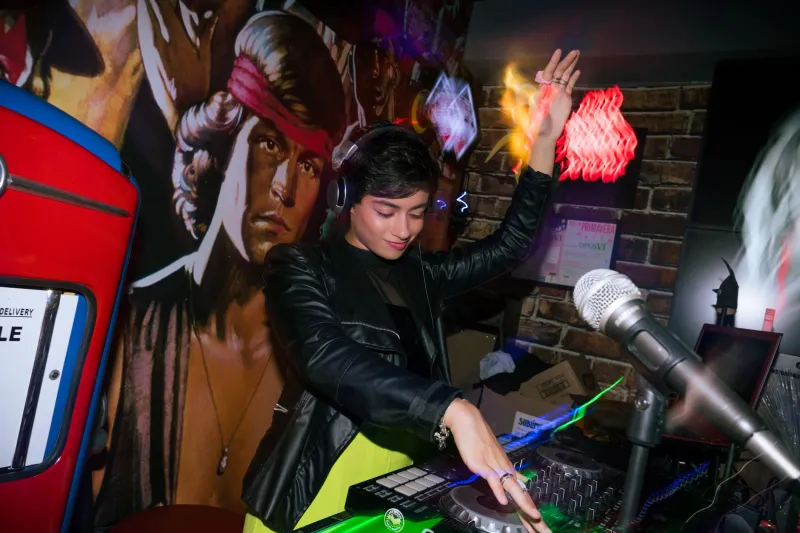
The interiors are their own taxonomy. There is the neon-and-mirror booth, all pink light and reflective surfaces, which flatters everyone and reveals nothing. There is the corporate booth, with grey upholstery and a screen that looks like it was rescued from a conference centre. There is the themed booth — K-pop, 80s, a vague tropical motif — where the design is doing most of the emotional labour. The microphone is always slightly sticky. The tambourine is always missing a few zills. The volume dial is either broken or set to “neighbour complaint”.
Read the room like a members’ club. The lighting tells you what kind of night you are meant to have: fluorescent honesty or neon theatre. The seating tells you whether the venue expects groups of four or groups of twelve. The presence of a coat hook, a bin and a working air-conditioning unit tells you someone has thought about it. The absence of those things tells you the booth is a cash machine with a sofa.
The Queue Is the Conversation
Etiquette in a British karaoke booth is unwritten but enforceable. The core principle is rotation: one song each, in order, no exceptions. The person who queues three songs in a row is a social threat. The person who queues a nine-minute power ballad at 8.45pm is a provocateur. The person who queues “Bohemian Rhapsody” and then leaves the room during it is a war criminal.
There is a ballad curfew, observed in most groups without discussion. Nothing too slow before the second drink. Nothing too sincere after the fourth. The group number is sacred — “Sweet Caroline”, “Dancing Queen”, the one that everyone knows the actions to — and should be deployed when energy dips, not when it peaks. The handover is a delicate moment: the outgoing singer must offer the mic with a gesture that says “your turn, I am magnanimous” rather than “please take this away from me”. The incoming singer must accept it without looking too eager.
And then there is the tap-out: the moment someone realises they have chosen a song they do not actually know. The correct response is to commit, mumble through the verses, and shout the chorus with enough confidence that nobody notices. This is the booth’s true social function. It is a room where being bad is not just permitted but expected, and where the only real failure is refusing to take the mic at all.
A Field Guide to the Booth
- Check the book. A worn song list is a good sign. A book that only contains songs from the last three years is a warning.
- Do the minimum-spend maths. Most UK booths set a spend per hour, not per person. A round of drinks and a bowl of chips will usually clear it; a round of waters will not.
- Book off-peak. Early evenings and Sunday afternoons are cheaper, calmer and more likely to give you the room you actually wanted.
- Ask about BYO. Some venues allow it, some charge corkage, some pretend not to hear the question. Always ask.
- Read the door policy. The best booths have a slightly chaotic queue and a person on the desk who knows exactly which room is free. The worst have a bouncer and a clipboard.
The Last Decent Social Club
The private karaoke booth is not glamorous. The screen is often dubious, the lighting is unkind, and the air is a mixture of stale pop and hope. But it is one of the few places left in Britain where a group of people can be together without an audience, without a schedule and without the pressure to be interesting. You sing badly. You sing loudly. You hand over the mic. The room holds you.
Book the box. Arrive early. Queue one song at a time. And when the timer runs out, leave the microphone on the sofa where the next group will find it — sticky, slightly too loud, and ready.