The Pasting Table Doctrine: Dressing, Haggling and Winning at Britain's Car Boots
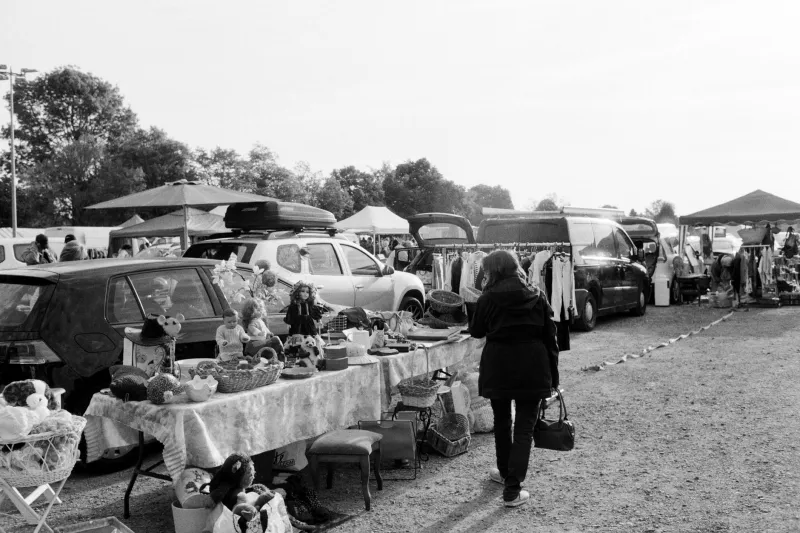
A car boot sale at seven in the morning is not shopping. It is theatre in the round, and the stage is a dewy field with a burger van at the far end and somebody's Volvo in the middle with its boot open and its whole life spilling out of it.
Here is how to play your part.
1. The outfit is the whole point
Wear what you bought at the last one. This is the only rule that matters. A coat from a man with a pasting table in Wiltshire, jeans from a woman selling out of IKEA bags in Cheshire, boots from a stall where everything was four pounds. Get asked where something is from and say, with genuine pleasure, 'a field in Devon, six years ago'.
Practicality does the rest. Layers, because it is freezing at half seven and you will be carrying someone's sideboard by eleven. A bag with a strap you can cross-body — you need both hands free for the rummage. No laces you care about. Cash in small notes, in a tin, in a pocket you can reach without taking the bag off.
And trainers. Not good trainers. The sort that have seen a wet field before and will not be emotionally damaged by another.
2. Arrive early, leave late, buy in the middle
The first hour is for sellers and dealers, and it is genuinely thrilling — doors on tailgates swinging up in the half-light, people unloading in a hurry because the good spots go first. Serious buyers walk it once at speed, before anything is even laid out, and make offers over the roof of a car. That is a legitimate sport and they will beat you at it.
The sweet spot is around half eight to ten. Prices are not yet desperate, the good things are not yet gone, and the field has hit its full, chaotic stride.
The last half hour is a different pleasure entirely: the great surrender. Everything must go, prices collapse, and you may find yourself loading a chair into the car and quietly wondering how much it would cost to reupholster a chair you did not plan to own.
3. The sales worth the drive
Britain is dense with these things and the best ones feel like regional institutions rather than markets. The big racecourse and airfield sales — Kempton Park out west of London, Ford Airfield near Arundel — are sprawling, professional, brutally early and full of proper dealers. Chelford in Cheshire is the sort of place where you can genuinely find something from a house clearance that has not been sorted, which is the dream. Rufforth, outside York, is enormous and wonderfully honest about it.
Then the smaller, stranger ones. Cricket clubs, village schools, showgrounds, the muddy field behind a pub with a hand-painted sign and forty cars and absolutely no rules. Check dates before you go. Half the charm is that half of them are irregular, weather-dependent, and announced on the internet at eleven the night before.
4. The etiquette of the haggle
You are not bartering. You are having a short, friendly, entirely formal conversation with a stranger about a quantity of money. There are rules.
Ask 'what's your best on that?' rather than naming a low number. It is polite, it gets you the actual price, and it does not imply the seller is a crook. Ask 'would you do it for a fiver?' when the sticker says seven — small asks, cheerfully made, work nearly every time. Never insult the item. It belonged to somebody, often somebody recently, and the person selling it is still in a relationship with it.
Bundle. Two things and a cheerful 'call it a tenner for the lot' is the single most effective move in British commerce. And learn the walk-away: 'I'll leave it, thanks' said without edge will, about one time in three, be followed by a voice behind you saying 'go on then'. If it is not, you have lost nothing and gained a story.
5. Learn to read the seller
There are archetypes, and they are all worth meeting.
The professional: van, rails, a card machine, everything sorted and priced. Reliable, joyless, will not budge. The house clearance: bags, boxes, no prices, an air of mild bewilderment, absolutely the best source of anything beautiful and underpriced. The bereaved family: polite, sentimental, quietly hoping you will look after it — be kind, pay properly, do not haggle. The child selling their old toys for a fiver towards a bike: pay the fiver, take the toy, do not argue.
And the man who knows what he's got. You will hear that phrase, or something close to it, and you should let him keep it.
6. An open-air museum of other people's houses
This is the real draw and it has nothing to do with bargains. A car boot is a house, at scale, turned inside out on a Sunday morning. Here is the wedding china nobody wanted to inherit. The exercise bike bought on a January high. Complete box sets of shows that ended badly. A framed print of a loch you have never visited. Every single one of somebody's glasses, in a shoebox, fifty pence.
It is curated by nobody and edited by everybody, and it tells you more about how Britain actually lived over sixty years than any museum with a glass case and a podcast.
7. What to actually buy
Textiles, always — blankets, wool coats, linen. Tools, which were made to be repaired and mostly still can be. Glassware, chairs, framed things, books with names written in them, cast-iron anything heavy enough to make you regret it at the car. Real leather, real wood, real cotton, and anything that has clearly outlived its original purpose and deserves another one.
8. Leaving empty-handed is a victory too
This is the one nobody tells you. You are allowed to walk four miles around a field, drink a tea that tastes of nothing, discuss the weather with six strangers and buy a single doughnut. The point is the field, the early light, the absurd pleasure of watching someone else's mothballed possessions get a second life in your hallway.
Wear the coat. Pay the fiver. Go home. Next Saturday you will be somewhere else, in a different field, still looking.