Trolley, Tray, Terracotta: The British Garden Centre Is Now a Weekend Social Club
At 10.58 on a Sunday morning, the car park of a British garden centre has the hushed expectancy of a theatre before curtain-up. Trolleys are being unchained. A man in a gilet is inspecting the boot of his car as though it were a stage set. Somewhere inside, a till is being counted in, and the first pot of tea is already brewing. This is not a DIY emergency. Nobody is here because a fence panel blew down in the night. They are here because the garden centre has quietly become one of the most reliable social venues in the country.
The Sunday Queue Is the Opening Act
The queue for the café tells you almost everything. It is rarely frantic. It has the patient, mildly festive atmosphere of a school fete that has learned to operate a card machine. Grandparents arrive early and secure a table by the window. Young families arrive slightly later, one adult holding a tray while the other performs a tactical sweep for highchairs. Couples in matching walking jackets debate whether a toasted teacake counts as lunch. The answer, by the way, is yes.
There is no rush, because the queue is part of the outing. It gives everyone something to do with their hands and a chance to study the specials board, which tends to read like a gentle parody of a British high street: soup, sandwich, cake, all reassuring, none of it demanding a decision more complicated than whether to have cream or butter.
A Floor Plan Written in Compost and Cardboard
Garden centres are often discussed as though they were merely shops. They are better understood as narratives. You enter through a seasonal display, which acts as a prologue. Then come the houseplants, glossy and photogenic. Next, the garden furniture, arranged in aspirational vignettes that suggest you too could own a pergola and a fire pit and a set of woven outdoor cushions in a shade called oyster. By the time you reach the compost, you are deep in the plot.
The trolley is a useful narrative device. It starts empty, then acquires a small bag of bulbs, a birthday card, a novelty tin of biscuits and a plant you did not plan to buy. This is not weakness. It is the garden centre's genius: it makes browsing feel productive. Even if you leave with nothing more than a tray of pansies and a scone, you have participated in a small, civilised drama of domestic improvement.
The Houseplant Aisle and the Art of Aspiration
The houseplant aisle is where the garden centre becomes a design showroom. Here are fiddle-leaf figs with their enormous, slightly theatrical leaves. Here are monsteras, calatheas, peace lilies and a rotating cast of succulents in tiny terracotta pots. The lighting is flattering. The shelves are stocked with the quiet promise that a £12 plant might change the mood of an entire room.
This is aspirational, but gently so. Nobody needs a permit to buy a fern. Nobody has to explain themselves to a sales assistant. A houseplant is a small, affordable renovation, and the aisle is a mood board you can wheel away. In 2026, when so much of the home has become a backdrop for video calls, a good houseplant is doing more work than some people's entire lighting scheme.
Seasonal Theatre, Performed in Mums and Mistletoe
Garden centres understand that the British year is a series of tablescapes. In spring, it is bedding plants and seed packets. In summer, it is barbecues and patio furniture. In autumn, it is pumpkins, heathers and wreaths. By the second weekend of November 2026, the Christmas displays are already up, which means the garden centre has entered its most theatrical phase. Reindeer are zip-tied to pergolas. Artificial snow is being fluffed. Somewhere a speaker is playing a cover of a Christmas song that nobody asked for, and yet it works.
The seasonal shift is not just commercial. It gives people a reason to return, a marker in the calendar, a low-stakes ritual. You do not have to buy a tree to enjoy the tree display. You can simply walk through it, admire the lights, and feel that the year is moving as it should.
The Café Is the Living Room
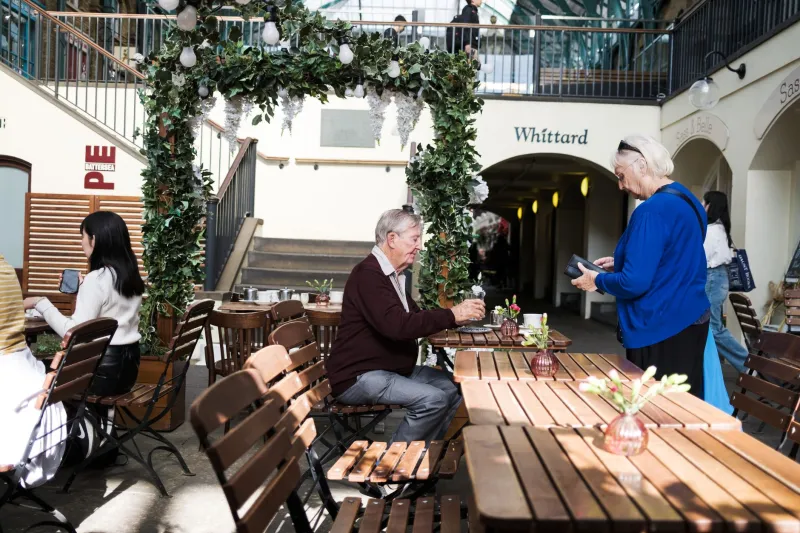
The café is not incidental. It is the destination. The garden centre café has become a kind of public living room, with laminated menus, sturdy chairs and a view of the car park that is somehow reassuring rather than bleak. It is where friends meet who do not want the formality of a restaurant. It is where grandparents take grandchildren for a treat that does not involve a cinema ticket. It is where you can sit alone with a pot of tea and a crossword and feel entirely at ease.
And then there is the tray. The tray is the great equaliser. Everyone carries one. Everyone has to find a table. Everyone has to navigate the same slight awkwardness of moving through a room while holding a hot drink and a slice of carrot cake. It is a small, communal performance, and it is oddly comforting.
Why It Works
Garden centres work because they ask very little of you. There is no ticket, no dress code, no need to pretend you know your pH levels from your potting grit. You can browse, buy a cactus, have a scone and be home by two. You can take a toddler to look at the fish pond. You can take a parent to look at the hanging baskets. You can take yourself to look at the houseplants and pretend you are considering a redesign.
In a country that often struggles to find places to gather that are neither too formal nor too expensive, the garden centre has become a quiet social club. It is part greenhouse, part café, part design showroom and part family outing. Everything goes to seed eventually, yes — but first, another pot of tea.