The Stackable Chair Is a Design Classic: Inside Britain’s Village Hall Renaissance
There is a particular smell to a village hall. Floor polish, faintly warm dust, the ghost of a hundred teas and one forgotten sandwich. It is not the scent of luxury. It is the scent of possibility. Give a community four walls, a kitchen hatch and a stage curtain that has seen things, and it will invent an entire social season.
In 2026, the village hall is having a quiet moment. Not a glossy revival with a branded tote bag, more a recognition of what was always there: Britain’s original pop-up culture, long before anyone called it that. The room can be a cinema on Friday, a ceilidh on Saturday, a jumble sale by Sunday lunchtime and a polling station by Monday morning. Try getting that flexibility out of a members’ club.
The architecture of almost anything
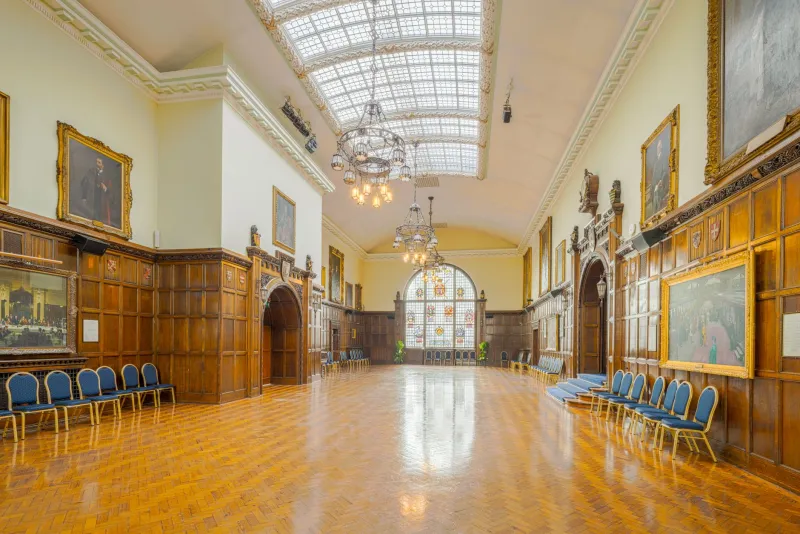
Village halls are not usually designed by names you would recognise. They are designed by necessity, fundraising and the practical optimism of a committee. A main room, a smaller room, a kitchen that can produce 80 cups of tea in under ten minutes, and a store cupboard containing exactly the right number of folding tables. The proportions are often plain but surprisingly generous: high ceilings, big windows, a floor that can take a trestle table and a dance floor without complaint.
The parquet is the giveaway. If you have ever watched a hall committee protect a parquet floor from heel marks, you have witnessed heritage management in action. It is also, in its modest way, a design statement. Parquet says this room was built for assemblies, celebrations and the occasional wedding disco. It says: we have standards, but we also have a mop.
Then there is the stage. Sometimes it is a proper raised platform with velvet curtains; sometimes it is a set of removable blocks and a lighting rig that amounts to two spotlights and a volunteer called Dave. Either way, it creates a focal point. A village hall without a stage is a room. A village hall with a stage is a venue.
A chair that knows its place
The stackable chair is the workhorse of British cultural life. It is not beautiful in the way a designer chair is beautiful. It is beautiful in the way a well-run bring-and-buy stall is beautiful: useful, communal, slightly battered and entirely without snobbery. You can stack forty of them in a cupboard, arrange them in rows for a film club, push them back for a ceilidh and form a loose semicircle for a supper club.
The chair also sets the social temperature. Rows mean audience. A circle means discussion. A scatter of chairs around small tables means cake and gossip. Anyone who has ever rearranged a village hall knows that seating is not furniture; it is diplomacy.
And then the tea urn. The tea urn is the room’s engine. It is also a piece of industrial design that deserves more respect than it gets: stainless steel, a tap that runs hot, a faint rattle that suggests it has been to every fundraiser since the 1970s. The urn is how the hall makes money, makes friends and makes a committee feel that the evening has been a success. Coffee may be available. Tea is the default.
Make-do-and-mingle glamour
What makes the village hall stylish is not the fixtures. It is the way people dress it up. A film club might hang a sheet, borrow a projector and serve wine from a plastic tumbler that is somehow still charming. A supper club might bring in mismatched crockery, a portable speaker and a menu typed in a newsletter font. A ceilidh fills the floor with noise and elbows. A jumble sale turns the same room into a temporary department store, where a good coat is a treasure and the book table is a public library in miniature.
The look is not curated in the online sense. It is curated in the community sense: borrowed, donated, repurposed, accounted for in a ledger. The result is an aesthetic that Pelia would like to nominate as a genuine British style: make-do-and-mingle. Nothing matches. Everything belongs.
Committee politics and the curtain question
We should not romanticise the hall too much. Behind every event is a committee, and behind every committee is a rota. Who has the key? Who booked the kitchen? Who put the chairs back wrong? Why is the stage curtain that colour? These are not small questions. They are the governance of local culture.
The committee is the unsung producer of British social life. It negotiates with the parish council, chases the insurance, decides whether the raffle can run, and maintains the delicate peace between the film club and the badminton group. It also knows where the good tablecloths are kept. In 2026, as more people look for venues that are affordable, flexible and genuinely local, that expertise matters more than ever.
Why the parish still sets the stage
The village hall has survived because it is adaptable. It does not need a concept. It needs a caretaker, a calendar and enough chairs. It can host a wedding reception, a toddler group, a writers’ circle, a repair café, a birthday party and a meeting about the bypass. It can be earnest and silly in the same week.
That is the lesson for anyone who thinks pop-up culture began with a shipping container and an Instagram grid. The original pop-up is the hall down the lane, with its stackable chairs, its tea urn and its hand-written notice by the door. It is not trying to be cool. It is trying to be useful. And in 2026, useful is a very stylish thing to be.
Bring your own chair if you must. But check the rota first. Someone will have left the key under the usual arrangement.