Strike Zone: How to Read Britain’s Bowling Alleys Like a Design Archive
There is a particular smell to a British bowling alley. Warm carpet, faint disinfectant, hot dog steam and the ghost of a thousand birthday-party squash drinks. You notice it before you notice the lanes. And then you notice the carpet itself—because in the best alleys, the carpet is not decor. It is the plot.
Britain has spent decades treating ten-pin bowling as a slightly embarrassing cousin to the cinema and the arcade. A place for school trips, hen dos and rainy Saturdays in a retail park. But look closer and you’ll find some of the country’s most underrated interiors: rooms where bold graphics, neon, timber, Formica and hand-painted type have been left to ferment into something genuinely distinctive. In 2026, a new generation is booking lanes for birthdays, dates and office nights out—and quietly discovering that the design is half the fun.
The interior is the attraction
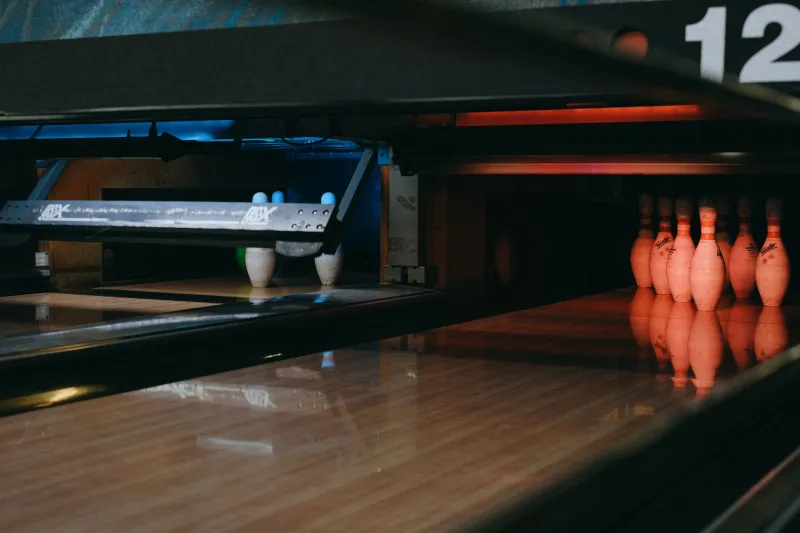
Most leisure venues try to disappear behind the activity. Bowling alleys do the opposite. The room is the event. You are meant to be aware of the scale, the noise, the glow. The lane itself is a long, polished stage; the seating area is a viewing box; the scoring screen is a little beacon of suspense.
Good alleys understand that bowling is theatre with a snack menu. The best ones lean into it. They give you a carpet with an unreasonable amount of confidence. They put a swooping neon sign above the shoe desk. They let the league boards go yellow in the corner rather than replacing them with a flat-screen slideshow.
That is not nostalgia for its own sake. It is atmosphere. And atmosphere is exactly what a generation raised on beige box restaurants and minimal hotel lobbies is now craving.
Carpet, neon and the art of glorious excess
The bowling carpet is a design genre all by itself. Cosmic swirls, confetti triangles, abstract squiggles, planets that look like they were drawn by someone who had heard about space but never seen it. At its best, the carpet is a riot of colour doing a very practical job: hiding scuffs, spills and the general traffic of a room built for joyful chaos.
But the carpet is only the opening act. Look up. The ceiling might be low and acoustic-tiled, or high and strung with neon. Look at the masking units above the pins—those panels are often the alley’s most elaborate canvas, carrying logos, slogans and graphics that feel like a lost branch of 1980s graphic design. Look at the shoe counter. Look at the fonts on the signage. Look at the scoring consoles, which in older venues have the clunky charm of a cash machine that has seen things.
This is where the design renaissance is happening. Not in a wholesale refurbishment that strips the soul out, but in venues that know when to restore and when to leave well alone.
League night is a design ritual
If you want to understand a bowling alley, go on a league night. The room changes. The lights drop a little. The noise sharpens. People arrive with their own balls, their own shoes, their own rituals. There is a lot of leaning on counters and studying of lane conditions.
League boards are the alley’s unofficial archive. Names, averages, sponsors, dates. Some are hand-painted; some are magnetic; some are held together with hope. They tell you who has been coming here for twenty years and who is new. They also tell you that a bowling alley is not a passive backdrop—it is a clubhouse with skittles.
That social function is why the best alleys feel like rooms rather than facilities. The seating matters. The bar matters. The way the lanes are arranged—whether you can see all of them or just your own—changes the whole mood. A good alley lets you be a spectator as well as a player.
Why 2026 is booking lanes
Part of it is price. Part of it is the pleasure of doing something that isn’t just sitting in a restaurant and performing contentment. But there is also a design story here. Bowling alleys offer a kind of visual abundance that has become rare. They are unafraid of pattern, colour and a bit of showbiz. They are also naturally sociable: you can talk, you can watch, you can eat badly and happily, and nobody expects you to be quiet.
For dates, it works because there is something to do with your hands. For office nights, it works because the scoring does the small talk. For birthdays, it works because the room is already a party. The new generation isn’t discovering bowling; it’s rediscovering what the room was always good at.
A short pilgrimage list
Bloomsbury Bowling Lanes, London. A proper central London institution with a retro feel and a sense of occasion. Good for design nerds who like their lanes with a side of basement glamour.
Rowan’s Tenpin Bowl, Finsbury Park, London. A neighbourhood alley with the kind of lived-in character that no amount of mood lighting can fake. Go for the lanes, stay for the atmosphere.
The Dog Bowl, Manchester. Part of a broader Manchester leisure cluster, it leans into the social side of bowling with a room that feels built for groups rather than silent concentration.
Lane7, various cities. The newer end of the spectrum, but smart about it. Lane7 understands that bowling works best when it is part of a wider night out—and its interiors tend to be sharper than the average leisure box.
All Star Lanes, London. Glossier and more polished, but useful if you want the bowling-alley ritual with a cocktail list and a booth. A good gateway for the unconvinced.
How to read the clues
Start with the carpet. Is it original, restored or a pastiche? Then look at the signage: hand-painted lettering is a good sign; generic vinyl less so. Check the scoring units—old ones can be charming, new ones can be ugly, and the way the venue handles that tells you a lot. Listen to the room. A good alley has a particular acoustic: pins clattering, balls thudding, people shouting encouragement. If it sounds dead, it probably feels dead too.
Finally, look at the people. Are there league shirts? Are there families who clearly come every week? Are there groups of friends who have booked two lanes and brought a cake? That is the real design feature: a room that lets different kinds of people use it without pretending to be something else.
The final frame
Britain’s bowling alleys are not museums of a lost Britain. They are working rooms with a very specific visual language—one that is louder, warmer and more generous than most of what gets built now. The carpet is the star, but it is not the whole story. The story is the way a room can be both ridiculous and completely serious about giving people a good night out. In 2026, that is worth celebrating. And maybe worth booking a lane for.