The Mirror Has a Memory: Inside Britain’s Barbershop Portrait Walls
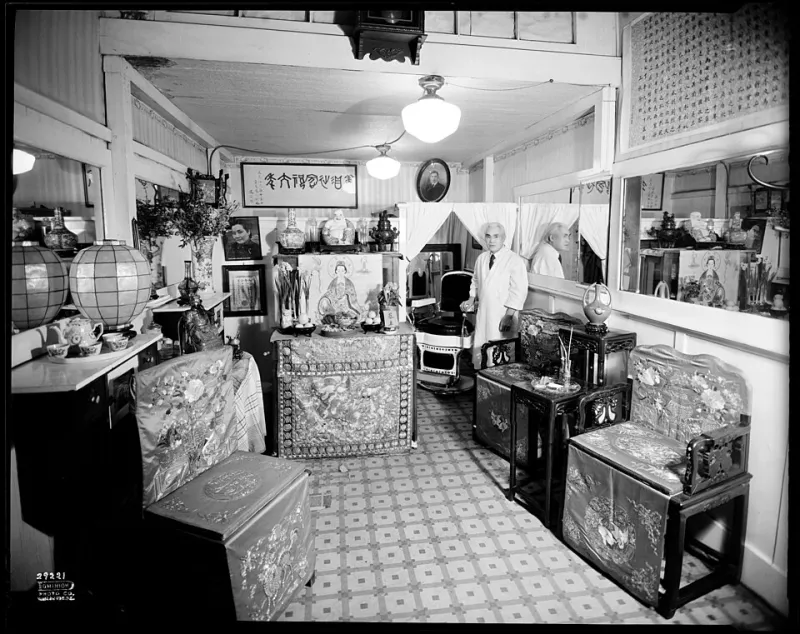
Photo: Vancouver Public Library Historical Photographs, No restrictions, via Wikimedia Commons
Walk into a certain kind of British barbershop and you will be met by a wall that has been quietly doing the work of a portrait gallery for decades. It is not hung by a curator. There is no wall text, no security guard, no gift shop. There is a strip of blue-tack, a few drawing pins, a frame from a charity shop and, above all, a rank of faces. Some are smiling. Some are mid-squint. Some are very young. Some are no longer with us. The photographs go up because someone brought one in, or because the barber took it on a phone and printed it at the supermarket, or because a local football team won a cup and the coach knew where to take the evidence.
This is not a gallery in the civic sense. It is something more useful: a live social archive, pinned to the same wall as the mirror and the clipper rack. The barbershop portrait wall is one of the high street’s last genuinely mixed, unhurried rooms, and its photographs are the proof.
The Wall Is the Archive
A proper barbershop wall is not arranged by colour palette. It is arranged by memory. A first haircut sits next to a faded shot from the 1990s. A wedding party crowds one corner; a five-a-side team occupies another. There are babies in cardigans, teenagers with curtains, dads with the same expression they have been wearing since the first photograph. There are faces that reappear every few years, older but recognisable, like a local version of a royal portrait series.
What makes the wall so honest is its lack of polish. These are not commissioned photographs. They are proofs, snaps, team photos, passport-adjacent headshots and the occasional picture that has been photocopied so many times it has become a rumour of a face. Captions are rare. Names are often unnecessary. The barber knows who everyone is, and if you are new, the wall tells you something else: this is a place where people stay.
The wall also records the work itself. You can trace haircuts the way a design historian traces chairs. The mullet, the undercut, the skin fade, the short-back-and-sides that has never really left. A photograph from a family wedding might sit beside a snapshot of a Saturday morning queue. The wall is not nostalgic in a soft-focus way. It is simply cumulative. It accepts whatever is brought through the door and pins it up, and in doing so it builds a portrait of a street that no council archive could commission.
Chairs, Mirrors, and the Theatre of the Ordinary
The barber’s chair is a stage, but it is also a witness. It has held nervous first-timers, toddlers on booster cushions, grooms on the morning of a wedding, and men who have come in for the same trim every three weeks for twenty years. The mirror above it is the frame within the frame. It reflects the wall back at itself, so that the photographs become part of the haircut. You sit down, you look forward, and there they all are: the regulars, the kids, the local team, the ghost of a haircut you had in 2004.
The tools matter too. The clippers on the shelf, the talc, the neck brush, the spray bottle, the radio that is always slightly too loud. These are not decorative. They are the machinery of a room where the atmosphere is doing as much work as the scissors. A good barbershop is not silent like a dentist’s surgery. It is conversational, occasionally chaotic, and entirely without the pressure to be productive. You are not there to be improved. You are there to be tidied.
That is why the walls feel so different from the sleek new versions of barbering that have arrived on the same high streets. The polished shop with the exposed brick and the single cactus can look lovely. But when the photographs come down and the walls are painted a tasteful shade of putty, something changes. The room becomes a service. The archive becomes a brand.
The Queue Is Part of the Design
The queue is not an inconvenience. It is a social room in its own right. In a British barbershop, the queue operates on a loose code: you ask how long, you take a seat, you look at the wall, you listen to the conversation. Nobody is trying to upsell you a membership. Nobody is asking you to rate your haircut on a tablet. The queue is a waiting room with better jokes and a wall of familiar faces.
This is where the mixedness of the barbershop really shows. The room gathers schoolboys, builders, dads, lads, older men, and whoever else has walked in because the lights are on and the price is fair. It is one of the few high street rooms where nobody is expected to buy a coffee to justify their presence. The wall holds all of them. The queue holds all of them. The chair takes its turn.
The Mixed Room
Barbershops are not perfect, and the banter can be as rough as a bad fade. But they are one of the last domestic-scale public rooms on the high street where people from different lives share the same space without a booking app or a dress code. The photographs on the wall make that visible. They are not a marketing campaign. They are a record of who actually comes in.
That is what makes the wall so quietly radical. It is not curated to flatter the business. It is curated by habit. A picture goes up because a customer brought it in, or because the barber liked it, or because a local team wanted to mark a win. The result is a portrait gallery where the sitters are not famous, the lighting is terrible, and the hang is chaotic. It is also the most honest exhibition on the street.
When the Walls Come Down
There is nothing wrong with a clean wall. A good shopfront can be a beautiful thing. But when every barbershop looks like a small branding agency with a pair of scissors, something is lost: the accumulated evidence of a place that belongs to its customers. The stripped-back wall says, ‘We are a concept.’ The photo wall says, ‘We are a Tuesday morning.’
You can feel the difference when you sit in the chair. A room with photographs has a longer memory than the person cutting your hair. It tells you that the shop has survived recessions, lockdowns, rent rises and the arrival of a rival three doors down. It tells you that the same chair has held three generations of the same family. It tells you that a haircut is not just a transaction but a small ritual of belonging.
Why It Matters
Pelia is interested in the high street as a design archive, and the barbershop wall is one of its most undervalued exhibits. It is not made by designers. It is made by barbers who had nowhere else to put a photo. It is not preserved in a museum. It is pinned next to a mirror and a calendar. And yet it records the things that design often misses: faces, habits, repeat visits, local teams, first haircuts, last haircuts, and the ordinary theatre of a room where people wait their turn.
Next time you sit down for a trim, look at the wall before you look at your phone. Someone has already curated it for you. The captions are missing, the frames are mismatched, and the lighting is unforgiving. But it is a portrait gallery all the same — and it is one of the few on the high street that is still open to anyone who walks in.