The Countdown Is a Set Piece: Britain’s High Street Christmas Lights Go Up Again
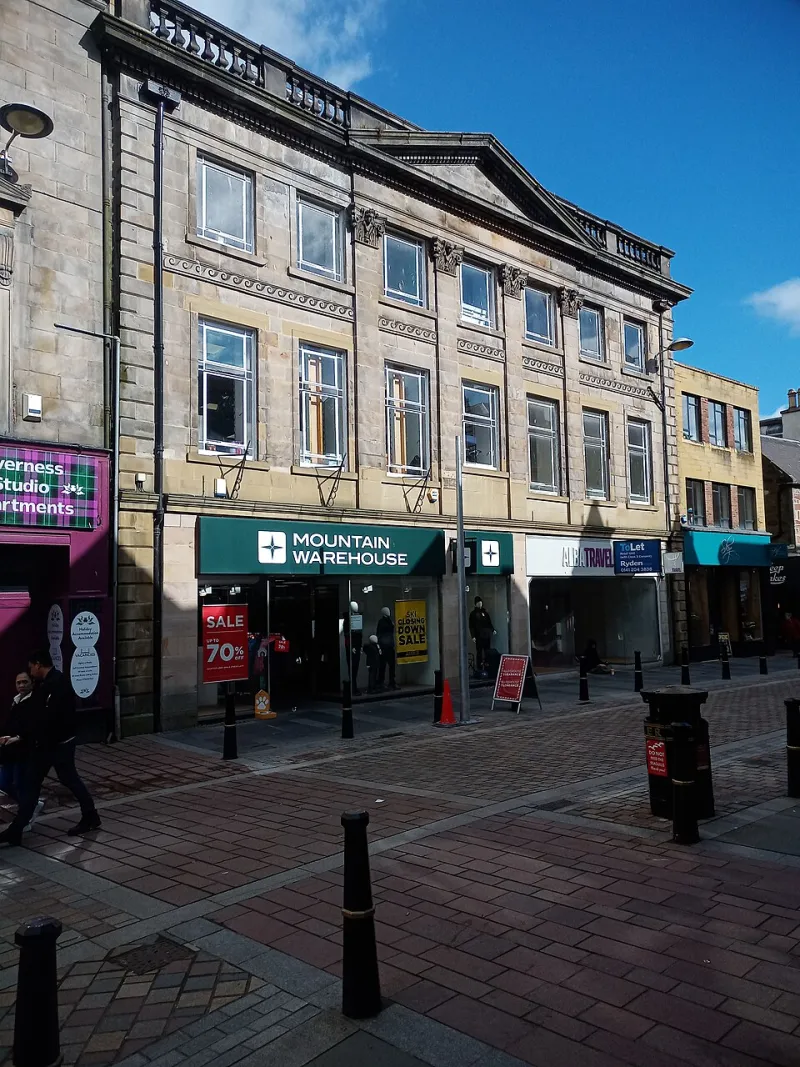
Photo: Victuallers, CC BY-SA 4.0, via Wikimedia Commons
By mid-November, the high street has already begun to rehearse. There is a cherry picker parked outside the pharmacy. A man in a hi-vis vest is arguing gently with a coil of cable. Somewhere above the pound shop, a string of bulbs flickers on, off, on again, as if the town is testing whether it still remembers how to glow. This is the week of the Christmas lights switch-on, and for one damp evening the shopping parade becomes something closer to a theatre.
It is easy to miss the design in all the tinsel. But the switch-on is a proper piece of temporary public architecture: a stage built from scaffolding, a lighting rig made of whatever the council could afford, a backdrop of shopfronts and bus stops, and an audience that has turned up in coats rather than evening wear. The show lasts about twenty minutes. The set remains until January. Consider this a Pelia field guide to the whole production.
The Scaffold Is the Set
Before the crowd arrives, the high street looks like a work in progress. Ladders lean against lampposts. Extension leads snake across the pavement. A local electrician, who has presumably been doing this since the lights were incandescent and the town was younger, tests a final motif above the baker’s. The motif is meant to be a reindeer. It reads, at a generous squint, as a reindeer.
This is the unglamorous half of civic design: cable ties, junction boxes, a borrowed generator, and the quiet anxiety of a fuse. The lights themselves are a mixture of old and new — some towns have upgraded to low-energy LEDs, others are still loyal to the warm, slightly faltering glow of bulbs that have done a decade of service. Neither is wrong. A high street’s lighting scheme is less about perfection than about continuity. The wonky star is not a mistake; it is a signature.
The best switch-ons understand that the street is already the set. The shop windows are the wings. The kerb is the front row. The bus shelter, lit from within, becomes a green room for teenagers. No one has to build a proscenium arch when the post office and the charity shop are already standing there, doing the work of civic scenery.
The Compere, the Choir, and the Countdown
Then comes the compere. Usually from local radio, sometimes from the local paper, occasionally from a panto cast in full costume and visible breath. They hold a microphone that whistles in the wind and say things like, ‘Are we ready, [town name]?’ The crowd, who are ready, say yes. The school choir sings two songs, one of which is not strictly a Christmas song but has been drafted in anyway. A child from the front row is invited to press the button. The button is not connected to anything, but that is not the point.
The countdown is the crucial piece of stagecraft. Ten, nine, eight — the crowd joins in with the slightly uneven enthusiasm of people who have been standing in the cold for twenty minutes. Three, two, one. The lights come on. There is a cheer. Someone’s phone camera flares. The star above the precinct, which has been waiting all evening to be noticed, does its small, wonky thing.
It is not sophisticated theatre. It is better than that. It is community theatre, with all the rough edges left in. The compere forgets a name. The choir’s backing track skips. The switch itself sometimes needs a second attempt. The audience loves it more for that. A perfectly polished switch-on would feel like an advertisement. A slightly chaotic one feels like a town.
What the Lights Say About a Town
Look closely at the scheme and you can read the local self-image. Some high streets go for restrained white and gold: tidy, classic, a little bit aspirational. Others go full disco, with coloured motifs and a snowman that appears to be wearing sunglasses. Some councils lean on sponsor logos, which is fair enough — civic glow does not pay for itself — while others have clearly raided the same catalogue for fifteen years and are sticking with it.
The design choices are never only aesthetic. They are budgetary, practical, and quietly political. A town that strings lights across the whole parade is saying something about its centre. A town that lights only the square is saying something else. The switch-on turns those choices into a public event, which is why it can feel oddly moving. For one evening, the high street is not a place to hurry through. It is a place to stand still and look up.
After the Applause
The crowd disperses slowly. Someone queues for chips. Someone else takes a photograph of the wonky star. The choir gets collected by parents. The compere thanks the sponsors. By tomorrow, the lights will be ordinary again — part of the commute, part of the school run, part of the background of a British winter. But the switch-on has done its job. It has reminded everyone that the street belongs to them, at least until the decorations come down in January.
That is the real design lesson. The high street Christmas lights are not just bulbs and cable. They are a temporary agreement to gather, to count down together, and to pretend for a few weeks that the shopping parade is a stage. It is a small piece of civic theatre, performed annually, with a wonky star and no dress rehearsal. And like all the best British rituals, it works precisely because no one is pretending it is perfect.