The Last Public Living Room: Britain’s Bus Shelters and the Art of Waiting
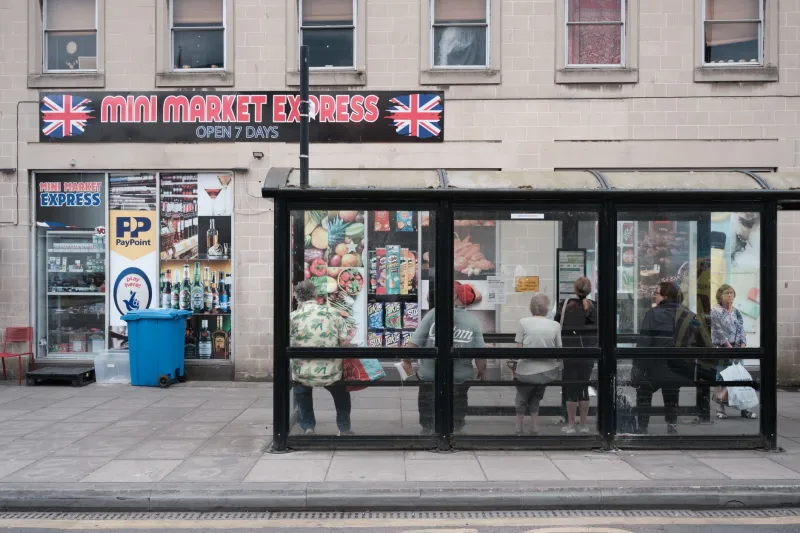
The bus shelter is not a building. It is a pause with a roof. It has no tickets, no bouncers, no loyalty scheme and no minimum spend. You can stand in one for twenty minutes in the rain, read a laminated notice about a missing cat, learn the bus timetable by heart and leave without anyone asking what you are doing there. In a country that has quietly sold off so many of its public rooms, that is no small thing.
We tend to look through bus shelters rather than at them. We look past the glass to see whether the number 42 is coming. We look past the bench to check the time. But the shelter itself is a small piece of civic design, a local noticeboard, a bench with politics and a stage for the daily theatre of waiting. It is one of the few places in Britain where strangers still share a room without a reason.
The Taxonomy of the Wait
There is no single British bus shelter. There is a whole family of them. The concrete brutalist box still stands in windswept corners of postwar towns, its aggregate surface pitted by decades of weather and cigarette burns. The glass-and-steel council issue is the most common: a transparent cube with a cantilevered roof, a timetable case bolted to one end and a bench that seems designed for perching rather than sitting. Then there is the Perspex lean-to outside a Co-op, the wooden Victorian-style shelter in a market town, the metal perch under a supermarket awning, and the frankly optimistic open-sided shelter that offers all the protection of a colander.
Each one is a barometer of local taste and local authority. A shelter with clean glass, a working timetable and a bin is a small civic boast. A shelter with a missing pane, a bench held together by cable ties and a faded notice about roadworks is a different kind of document. It tells you about budgets, yes, but also about care. The best shelters are not necessarily the newest. They are the ones that have been noticed.
Bench Politics and the Unwritten Rules
A bus shelter is a room with furniture, and furniture arranges people. The long bench is the classic. It invites the teenager with headphones at one end, the older person with a shopping trolley at the other, and the person who stands just under the lip of the roof because they do not want to commit to sitting down. The bench is a lesson in negotiated space. Bags go on seats until someone asks. Someone always leaves a gap. Nobody sits in the middle unless the shelter is full.
Then there is the anti-sit bar, the sloped ledge, the metal armrest that divides the bench into polite parcels. These are design decisions with attitudes. They say: wait, but do not get too comfortable. They are also, quietly, a comment on who is allowed to linger. The shelter is a public room, but it is not a free-for-all. It has its own etiquette. The person who knows the timetable becomes a temporary oracle. The person who arrives last stands nearest the road. The person who talks to strangers is either lonely, kind or both.
The Noticeboard Without an Editor
The noticeboard is where the shelter becomes a publication. Lost cats. Guitar lessons. A church fête. A warning about fly-tipping. A handwritten card offering garden clearance and a phone number with the last digit torn off. Stickers layer over stickers. Someone has scratched initials into the glass. Someone has left a free newspaper folded on the bench. The shelter is the last unedited wall in the neighbourhood, and it is all the better for it.
The bus timetable itself is a strange kind of literature. Route numbers. Destination names. The small print about not all stops. The laminated case with a corner that has come unstuck. You can learn a lot about a place from the destinations it lists and the ones it has quietly stopped mentioning. The shelter is a local archive, whether it means to be or not.
Small Architecture, Serious Comfort
Good shelter design is harder than it looks. It must block wind without blocking light. It must offer a bench at the right height and a timetable at eye level. It must cope with rain, sun, litter, graffiti and the odd act of vandalism. It must be visible from the road but not so visible that it feels like a stage set. The best ones have a certain modesty. They do not try to be landmarks. They try to be useful.
The worst ones fail in small, predictable ways. The roof that funnels rain onto the bench. The glass that is never quite clean. The bench that is too high, too low, or too obviously hostile. The shelter that faces the wrong way, so the wind finds you anyway. These are not glamorous design problems, but they are the ones that matter when you are standing in one at 7.40am in November.
The Theatre of the 4:17
Every bus shelter has a daily performance. It begins with the gathering: the slow accumulation of people who have done this before. Then the synchronised lean forward when a bus appears in the distance. The false alarm when it turns out to be the wrong number. The person who checks the timetable again, as if it might have changed in the last four minutes. The small release of tension when the bus finally arrives and the shelter empties.
The wait is a social room with a built-in exit. People talk more in shelters than they do at uncovered stops. The weather gives them a script. The timetable gives them a shared subject. The bench gives them somewhere to put their shopping. It is not a friendship, exactly. It is something older and lighter: a temporary agreement to share the same small space without needing to explain why.
Why the Humble Shelter Matters
The bus shelter is one of Britain’s most honest public spaces. It asks nothing of you. You do not have to buy a coffee to sit down. You do not have to dress for it. You do not have to pretend you are going somewhere more important. It is a third place with a timetable, a waiting room without walls, a bench with a view of the road.
At Pelia, we are partial to the overlooked design object, the accidental social club, the small civic room that does more than it says on the tin. The bus shelter is all three. So next time you wait, look at it rather than through it. Check the notices. Read the timetable. Sit for a minute if the bench allows. It is not a landmark, but it is a place. And there is always a bus coming.