Under the Table: Britain’s Pub Carpets Are the Country’s Most Democratic Design Archive
You notice it on the way out, usually. A pint down, coat half on, and there it is: a swirl of maroon and mustard, a fake crest, a geometric repeat that looks like a carpet designed by someone who had heard about heraldry but never actually seen a coat of arms. It is the most looked-at and least considered surface in Britain. We spill on it, stand on it, queue on it, and then wonder why the pub feels wrong when a refurbishment replaces it with grey planks and a wall of exposed brick.
First, the Pattern Does the Work
A pub carpet is not trying to be tasteful in the way a hotel lobby carpet is. It is trying to survive. The busy pattern — foliage, lozenges, mock-heraldic motifs, psychedelic curls, those strange little floral explosions that look like a wallpaper sample from a parallel 1970s — is a practical invention. Dark grounds hide stout, red wine, cigarette ash from the days when that was a thing, and the general grime of a room where hundreds of people have stood in wet coats. The pattern also hides the joins, the wear paths, and the fact that the carpet has been down since the brewery’s last big push.
There is a design intelligence in that. A plain carpet in a pub is a confession. A patterned one is a strategy. And the best examples have a kind of confident ugliness that becomes beautiful through repetition — the same quality that makes a London bus seat or a seaside arcade carpet feel like a piece of folk art rather than a mistake.
A Short History of the Patterned Floor
The pub carpet as we know it is largely a post-war story. In the 1950s and 1960s, brewery refurbishments moved carpet from the lounge into more of the pub, using it to signal comfort, warmth and a step up from the public bar’s lino. By the 1970s and 1980s, the carpet was standard issue: Axminster and Wilton weaves, often from the mills of Kidderminster and the West Country, made to withstand feet, chairs and the occasional dropped plate. The pattern was specified, not chosen by a landlord with a mood board.
That is part of why it feels so anonymous and so specific at once. These were commercial designs, produced in quantity, but they were also local. A carpet woven for a brewery’s estate carried a house style: the same red, the same gold, the same slightly mad repeat. It was branding before branding got loud. And because pubs were tied to breweries, the carpet was one of the few interior choices a landlord could not easily undo.
The Carpet Is a Map
Look down in a proper old pub and you can read the room. The carpet starts where the lounge begins. It stops where the food service or the pool table takes over. A change in pattern marks a change in status, even if the status is only ‘this side has cushions’. Wear patterns tell you the route to the bar, the route to the toilets, and the spot where everyone stands when the band is on. The carpet is a soft instrument of zoning — a way of making a single room feel like several without building walls.
It also does acoustic work. Carpets absorb noise, which is why a pub with a good one feels hushier and more conspiratorial than a pub with hard floors and a playlist. They warm the room, literally and socially. And they give a pub that particular smell — beer, dust, floral cleaning product and old wool — that no candle can replicate.
Why We Rip Them Out
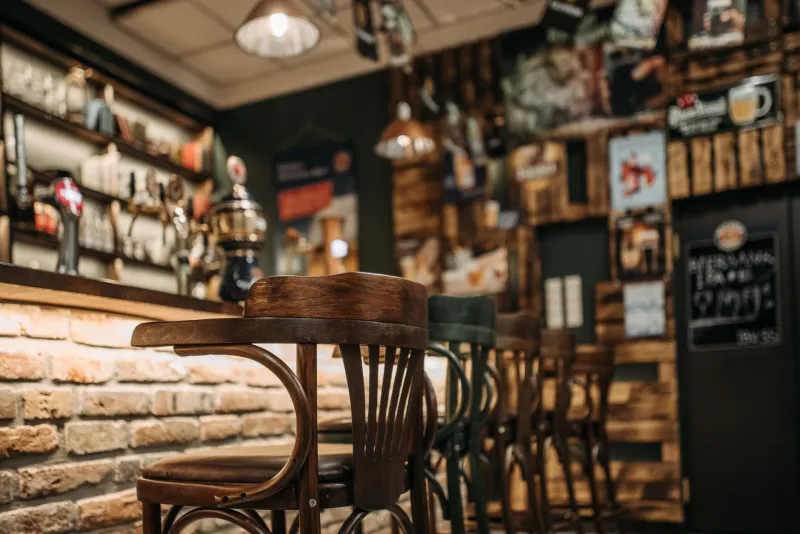
We rip them out because fashion is cruel and because ‘sticky carpet’ became a joke that stuck. Hard floors are easier to clean, easier to photograph, easier to sell as a ‘modern British pub’. A generation of refurbishments stripped out the pattern and replaced it with something that looks like a Scandinavian apartment. The result is often perfectly pleasant and completely forgettable.
The heritage sector has noticed. CAMRA’s pub interiors inventory and Historic England’s listings have long argued that the interior matters as much as the façade, but protecting a carpet is a tricky business. It is not a building. It is a surface. It gets replaced when it wears out, and no one thinks to photograph it first. The loss is quiet, which is exactly how vernacular design disappears.
The New Custodians
In 2026, the revival is less about reissuing a 1974 pattern than about taking the idea seriously. A new wave of landlords and designers is commissioning Axminster-style carpets again — sometimes faithful, sometimes abstract, often made by the same British mills that have been weaving them for decades. The best new versions do not pretend to be vintage. They use the logic of the old carpets: strong pattern, dark ground, a bit of wit. They hide the spills and they hold the room.
That feels right for a pub. The carpet was never precious. It was democratic. It was designed for people who might not notice it, and it worked anyway. Preserving that spirit means not turning it into a museum piece, but letting it do its job: soften the noise, mark the territory, and give the floor something to say.
Next time you are in a local, look down before you leave. The pattern under your feet is a small, strange, deeply British design archive — and it is still open to the public.