Forty-Five Minutes of Fame: Britain’s Nail Bars and the Art of the Personal Exhibition
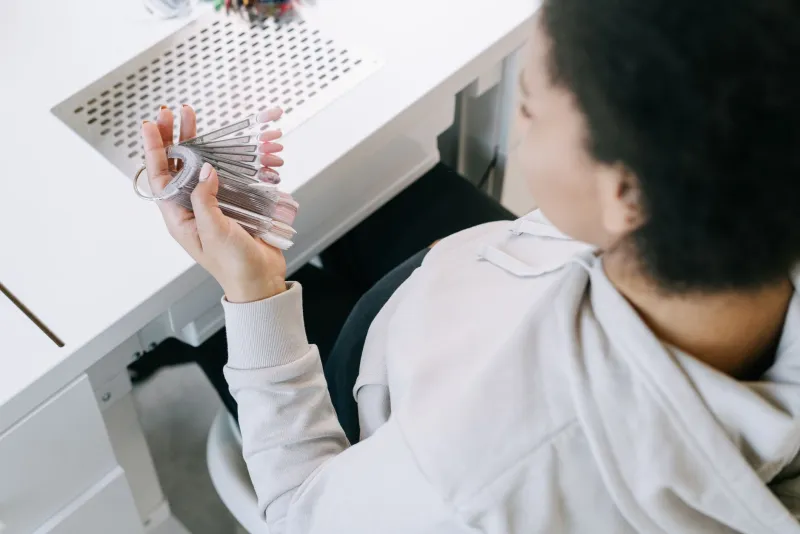
It is 4pm on a wet Thursday in November, and the nail bar between the vape shop and the charity shop is doing steady business. The window says walk-ins welcome in neon cursive. Inside, six stations glow under UV lamps, a fan turns slowly, and the air smells of acetone and citrus hand cream. A woman in a raincoat is choosing a set from a swatch wheel as if she were picking wallpaper for a room she will only live in for three weeks.
This is not a frivolous transaction. It is a consultation, a commission and a small private view, all conducted in the time it takes to listen to one podcast episode. The nail bar is one of the high street’s most reliable galleries, and its collection changes every fortnight.
The swatch wheel is the catalogue
The swatch wheel is the first clue. It looks like a colour chart, but it behaves like an archive: hundreds of tiny painted tips, arranged by mood, season and level of ambition. Nudes and milky pinks for the office. Chrome and cat-eye for a birthday. A single hand-painted holly leaf for December. The names are a vernacular poetry: champagne, bubblegum, mocha, glass. The technician fans the wheel out like a dealer showing prints, and the client narrows the field with the seriousness of a curator choosing a hang.
The conversation that follows is rarely about colour alone. It is about shape, length, material, maintenance. Gel or builder gel. Almond or square. A French tip is a classic; a micro-French is a wink. Nail art is legible at thirty centimetres, which means it can be subtle without disappearing. It is a small canvas, but it is not a minor one. On a hand holding a Oyster card, a coffee cup or a pint, it is in constant public circulation.
A room that edits itself
The interiors of these places are often overlooked because they are not styled in the magazine sense. They are accretive. A price list laminated and re-laminated. A shelf of gel bottles arranged like a paint store. Plastic plants that have survived three shop refits. A noticeboard of loyalty cards, opening hours and a hand-written sign about late cancellations. The UV lamp is the spotlight; the massage chair is the front-row seat; the drying time is the interval.
What makes the room interesting is how efficiently it edits itself around the people in it. Regulars have their preferred station without anyone assigning it. The chat moves between school runs, football results, holidays and the weather. In cities, several languages might run in parallel along the row of desks. The nail bar is a social club with a very specific membership fee: forty-five minutes and a willingness to hold hands with a stranger.
The technician as curator
The technician is the curator, and the job is more editorial than it looks. A good technician reads the hand, the wardrobe, the occasion and the client’s patience. They know when to suggest a simpler shape, when to talk someone out of a trend that will date by Friday, and when to simply paint the thing they have been asked for. They are also archivists. They remember your last set, your holiday, the wedding you were nervous about. In a small room, memory is a service.
It is intimate work. You sit close. Your hands are held. There is small talk, or there is comfortable silence. The technician works with a brush finer than most people use for anything, and the precision is quietly impressive. The result is a piece of personal style that will be seen in the wild, at the till, on the bus, in the office kitchen. It is not a painting for the wall. It is a painting for the world.
Hand held: the private view
The private view happens on the way home, in the dry air of a bus or the yellow light of a corner shop. You look at your hands differently for a day or two. You notice them opening a door, holding a phone, paying for something. Then the set settles into ordinary life, which is exactly the point. It is designed to be lived in.
The nail bar does not need a white cube or a press release. It has a swatch wheel, a UV lamp and a chair that reclines a little too far. It has a queue on a Saturday and a loyalty card in a drawer. It is a studio, a club and a folk-art archive rolled into one, and it is hiding in plain sight on the high street, between the vape shop and the charity shop, waiting for the next walk-in.