The Last Unbranded Room: Britain’s Chip Shops and the Genius of Just Getting On With It
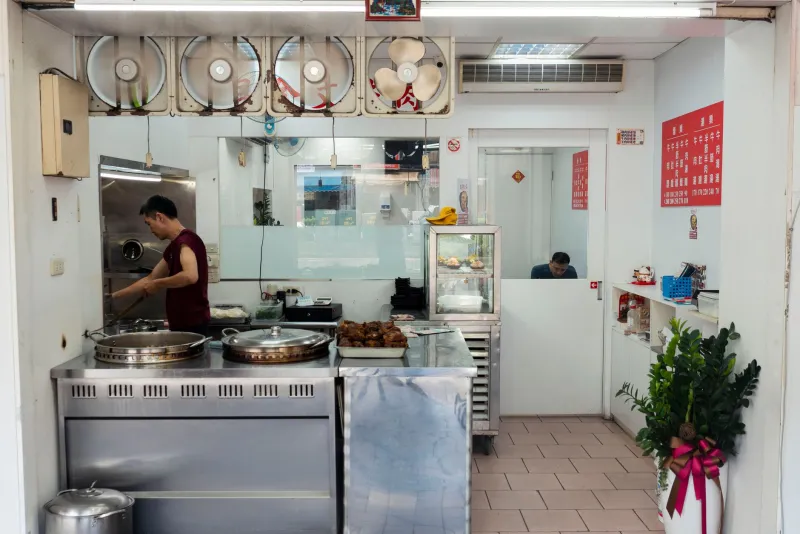
Walk into a good chip shop and you can read the room in about four seconds. Not because it is designed to be read — quite the opposite. The information is all there in the condensation on the glass, the laminated notice about card payments, the stack of wooden forks, the vinegar bottle with its cap half-melted. It is a room edited by use rather than by a creative director, and that is precisely why it works.
The Interior Is a Working Document
Those tiled walls are not a heritage statement. They are there because they wipe clean. The same goes for the stainless steel counter, the extractor fan, the strip light, the wipe-down menu board. Every surface has a job, and the job is usually heat, grease, or speed. The result is a palette of white, chrome and chip-shop yellow that no mood board would dare propose and no chain has quite managed to fake.
This is design as maintenance rather than reinvention. Nobody at the chippy is asking whether the room speaks to a brand pillar. They are asking whether the fryer is up to temperature and whether the queue is moving. The aesthetic is a by-product of those questions, which is why it feels so settled. A chip shop does not need a concept. It needs a good extractor and a clean floor.
The Menu Board Is the Local Newspaper
Menu boards are where typography goes to be useful. Moveable plastic letters. A chalkboard with yesterday’s special half-rubbed out. An A4 printout taped at a slightly apologetic angle. None of it is trying to be charming, and that is exactly why it is.
The menu also tells you where you are. In Edinburgh, salt and sauce. In Hull, chip spice. In parts of Yorkshire and Lancashire, scraps. Mushy peas, curry sauce, pickled eggs, battered sausages and the quiet controversy of gravy. These are not marketing decisions; they are local dialect written in batter. A chip shop menu is a public record of what people actually order, updated by habit and hung above the till for everyone to see.
The Queue Has a Choreography
Order at the till, pay, step to the left, wait, collect, leave. Nobody teaches it; everybody knows it. The queue is not an inconvenience to be designed away. It is the social channel. You hear about the roadworks, the school fete, the way the bus route has changed. The staff remember regulars by their order and their small talk. The whole thing runs on unspoken rules and a shared understanding that the person ahead of you is not in your way; they are simply part of the process.
Salt, Vinegar and the Small Ceremony
The final act is a ritual of almost liturgical simplicity: salt, vinegar, a paper wrap, a wooden fork. The vinegar is not really a flavour; it is a punctuation mark. The salt is applied with a practised shake. The bag goes warm against your coat on the walk home. The first chip is always too hot, and that is part of the contract.
It costs very little and asks very little. That is the point. The chippy is one of the last places in Britain where a small ceremony is available to everyone, no booking required.
A Democracy With a Fryer
No dress code. No minimum spend. No need to know which fork to use. Cab drivers, nurses, school kids, retirees, people who have just left the pub and people who are about to arrive. The chip shop does not ask you to socialise; it just lets you stand in a warm room and wait for something good. It is one of the few public rooms left where you can be alone without feeling lonely.
What the Chains Could Learn
High street chains spend fortunes trying to look like they have been there for decades. Chip shops actually have. The lesson is not to be nostalgic. The lesson is to be useful. Keep the tiles. Fix the extractor. Write the prices clearly. Do not put a neon sign where a menu board belongs. The chippy is not a concept; it is a service. That is the design.
The best chip shops are not curated. They are maintained. They are honest rooms: honest about heat, grease, hunger and the fact that dinner does not need a backstory. In a country that loves a rebrand, the chippy is a quiet holdout — a room that has not been refreshed because it was never trying to be anything other than what it is. And that, in the end, is the most stylish thing on the high street.