The Green Room: Britain’s Snooker Halls and the Art of Paying Attention
There is a particular smell to a British snooker hall: chalk dust, flat lager, faintly warm carpet and the metallic ghost of old coins. It is not the smell of a museum. It is better. It is the smell of a room that has been used properly for decades, by people who know exactly where to stand, when to keep still and how to hold a cue without showing off. In 2026, that room is still with us — though rather fewer of them than we might like — and it deserves to be read less as a relic and more as a design classic hiding in plain sight.
The Architecture of Hush
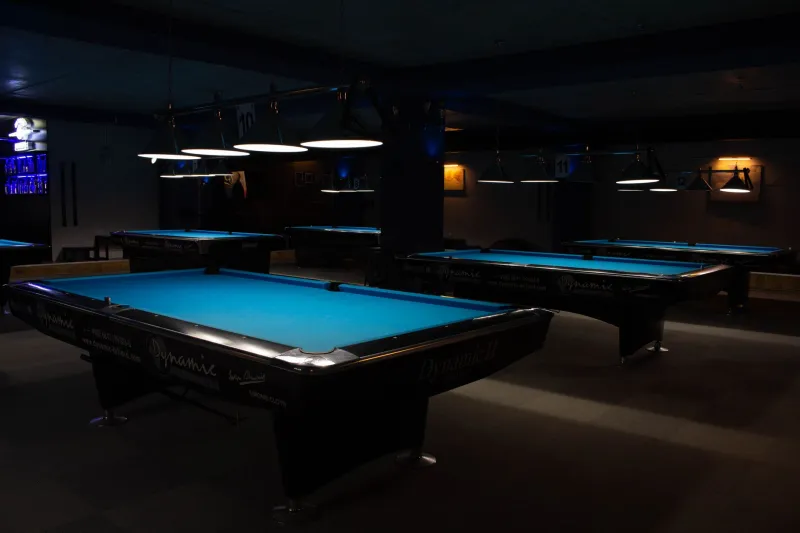
Snooker halls are rarely designed by architects in the glossy-magazine sense. They are designed by practical people solving practical problems: how to fit six tables into a space that must feel both large and intimate; how to light the baize without lighting the faces of the people watching; how to keep noise low without making the room feel like a library. The answer, arrived at again and again across the country, is a kind of accidental genius. You enter through an unremarkable door, often up a staircase or down a corridor, and the city falls away. The ceiling might be low. The carpet might be patterned in a way that suggests someone made a decision in 1987 and has stood by it since. And then there is the green: six or twelve rectangles of baize, glowing under their own low-hanging lamps, arranged with the gravity of a formal garden.
The hush is not a rule so much as a material. It is built into the room by the thickness of the carpet, the height of the ceiling and the way the tables are spaced. It makes you walk differently. It makes you put your phone away, or at least feel guilty about it. It makes the click of a cue ball sound like a small event.
A Palette of Green and Lamplight
Look up. The lamps are the unsung heroes of the snooker hall: long, low shades, usually green or black, suspended just above the table so that the baize becomes the brightest thing in the room. They do not flatter the players. They do not flatter the spectators. They flatter the game. This is lighting as pure function, and it happens to be beautiful.
The fluorescent strips overhead are the other half of the story. They are not glamorous. They are honest. They give the room its slightly institutional glow, the sense that this is a place for getting on with things. Against that flat white light, the green baize reads as a colour rather than a surface, and the wooden scoreboards — those sliding discs, those little brass hooks — become the room’s folk instruments. Every hall has its own version. Some are polished. Some are chipped. All of them are more interesting than a digital screen.
The Scoreboard as Folk Instrument
A snooker scoreboard is a small piece of interactive design that has never needed an upgrade. You slide a disc. You move a marker. You keep time with your hands. The best ones have a patina that no app could fake: the worn edge of a number, the slight stickiness of a runner that has been pushed ten thousand times. They are also social objects. To watch someone keep score is to watch a small performance of competence — the quick glance at the table, the confident slide, the quiet correction.
If you are visiting a hall for the first time, spend a minute with the scoreboard. Notice where it sits in relation to the table. Notice how the scorer positions themselves. It is a reminder that the room is not just for playing; it is for keeping track, for paying attention, for being part of the game without holding a cue.
Tiered Seating and the Art of Spectating
Not every hall has raked seating, but the good ones have somewhere to sit that is slightly above the action — a bench, a few chairs, a ledge. This is the snooker hall’s equivalent of a theatre balcony: a place to watch without intruding. The etiquette is simple. Sit still. Keep your voice low. Do not walk across the sightline. Do not let your phone screen light up the dark. These are not arbitrary rules; they are the social contract that makes the room work.
And there is pleasure in that restraint. In a culture that rewards loudness, the snooker hall asks you to be quiet and useful. You hold the room steady while someone else takes their shot. It is a small, civilising thing, and it is becoming rarer.
A Field Guide to Appreciation
The best way to love a snooker hall is to use it. Book a table at an off-peak hour. Order a tea from the hatch, if there is one. Watch the regulars; they will show you how the room works. Notice the cue rack, the chalk on the rail, the way the light falls. Look at the carpet, the curtains, the notices on the wall. These are the details that make the place what it is. And if you are lucky enough to find a hall with its original scoreboard and lamps still in place, treat it as you would any good interior: with respect, with curiosity and with the understanding that it was never designed to be looked at, only used.
That is the paradox of the British snooker hall. It is a design classic that never sought the title. It is a third place that asks for nothing but your attention. And in 2026, as more of them close or swap baize for screens, the quiet green room feels less like a relic and more like a lesson in how to make a space that people actually want to stay in.