The Plastic Chair Knows Everything: A Field Guide to Britain’s Garage Waiting Rooms
The garage waiting room is not designed. It accumulates. That is the first thing to understand about it. Walk into any MOT bay or back-street repair shop from Peckham to Preston and you will find a room that has been furnished by accident, maintained by habit and decorated by whatever the tool supplier sent in 2019. It is the opposite of a mood board. It is a ledger.
And yet, as interiors go, it is unusually honest. There is no lighting scheme. No playlist with a name. No one has been paid to arrange the chairs. The result is a space that tells you exactly what kind of place you are in, and exactly what kind of people run it. If you want to understand how Britain actually works — trust, tea, mild improvisation — you could do worse than sit in one for forty-five minutes with a lukewarm brew and a copy of a car magazine from before you owned a car.
The chair is the archive
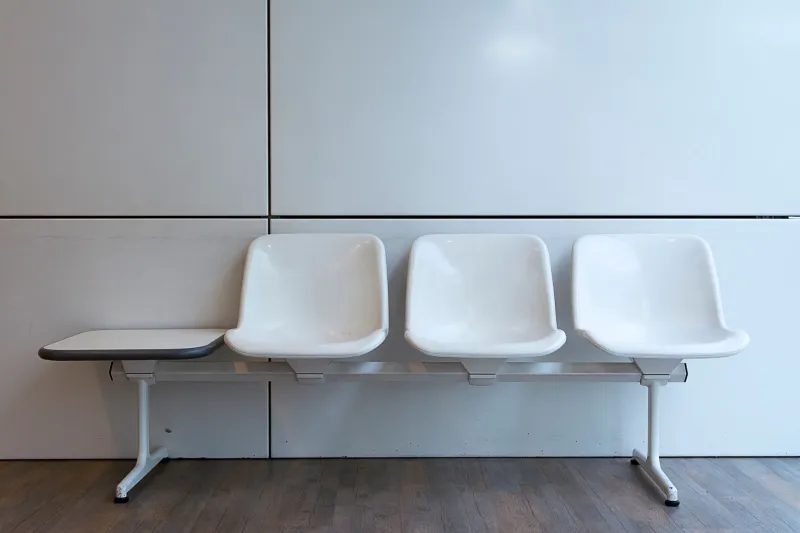
Start with the seating. A garage waiting room rarely has a matching set. It has a typology: the plastic stacking chair with the scuffed leg; the office swivel that has lost its gas lift; the upholstered tub chair that came from a relative’s spare room and now smells faintly of WD-40. Each one has a biography. The good chair is usually nearest the radiator. The wobbly one is by the door. Nobody has labelled them, but everybody knows.
This is design by negotiation rather than decision. In a café, a mismatched chair is a styling choice. In a garage, it is a fact of life. That distinction matters. The room is not trying to say anything about itself, which is precisely why it says so much. You can read the age of the business in the furniture. You can read the owner’s tolerance for discomfort. You can read whether anyone has ever thought: we should probably get rid of that.
A magazine rack with a memory
The reading material is not content. It is sediment. There will be a Haynes manual for a car that no longer exists. A trade catalogue for brake pads. A local free paper from a fortnight ago, folded to the classifieds. And somewhere near the bottom, a glossy motoring magazine with a cover star so dated it functions as a small archaeological find.
Then there are the calendars. The mechanic’s calendar is its own genre: tool brands, tyre adverts, a slightly weary joke about oil changes. It is not ironic. It is not curated. It is simply the visual wallpaper of a working life. If the waiting room is an accidental design archive, the calendar is its most reliable dating tool. You can carbon-date a garage by the promotional freebies on the wall.
Kettle diplomacy
The kettle is the reception desk. In many garages, it is also the entire customer service strategy. You will be offered tea. You may be offered coffee, though the coffee is often a granulated rumour. The offer is the point. It is a small protocol of trust: you are not just a transaction; you are a person who has been temporarily parked.
This is where the waiting room becomes a civic space. Conversations start without introduction. Someone complains about the council. Someone else recommends a plumber. A mechanic comes in with an oily hand and says something reassuringly vague about a bush. The local gossip is not gossip, exactly; it is a low-level information network. Who’s good with electrics. Which roundabout floods. Where the MOT man is on holiday next week.
The kettle also enforces a kind of equality. Everyone gets the same mug. Everyone waits in the same chair. The room does not care whether you arrived in a company van or a leased hatchback. It is one of the last places in Britain where queuing is not a competitive sport.
The noticeboard is the high street in miniature
Look at the wall. There is usually a noticeboard, or a window ledge doing the job of one. A handwritten sign about opening hours. A laminated warning about parking. A business card for a mobile locksmith. A poster for a charity raffle. A small ad for a dog walker, with tear-off tabs.
This is the high street in miniature, stripped of branding and estate-agent gloss. It is also a reminder that the garage is a local institution, not just a service. It knows the streets around it. It knows which customers need their car back by school pick-up. It knows who will pay on Friday. The waiting room is where that knowledge becomes visible, pinned up next to a reminder about winter tyres.
The window is the theatre
There is always a window, usually smeared, often with a view of the forecourt. This is the waiting room’s quiet drama. You watch your car being raised on a ramp. You watch a mechanic disappear behind a wheel arch. You watch the high street at walking pace: a delivery bike, a dog, a neighbour you have not seen since March.
It is not a view. It is a position. You are inside a working building, looking out at a working street, with nothing to do but observe. In a world of curated interiors and destination coffee, that is almost radical. The garage waiting room does not ask you to be entertained. It asks you to wait, and to notice.
The field guide
If you find yourself in one, read it closely. The chairs: mismatched, hierarchical, faintly sticky. The table: a low formica survivor, scattered with leaflets about brake fluid. The smell: oil, rubber, tea, a ghost of cigarettes from a previous regime. The soundtrack: local radio, faintly distorted, interrupted by a phone that rings like it is 1998. The dress code: whatever you wore to work, plus a coat you did not plan to keep on.
The aesthetic is not styled. It is negotiated. And that is why it works. The garage waiting room is the nation’s most honest interior because nobody is trying to impress you. It is a room built around trust: your car is in their hands, your tea is in yours, and the plastic chair knows everything.